

Desperate
Sharp-shinned hawks, the metabolic knife's edge, and showing up impaired

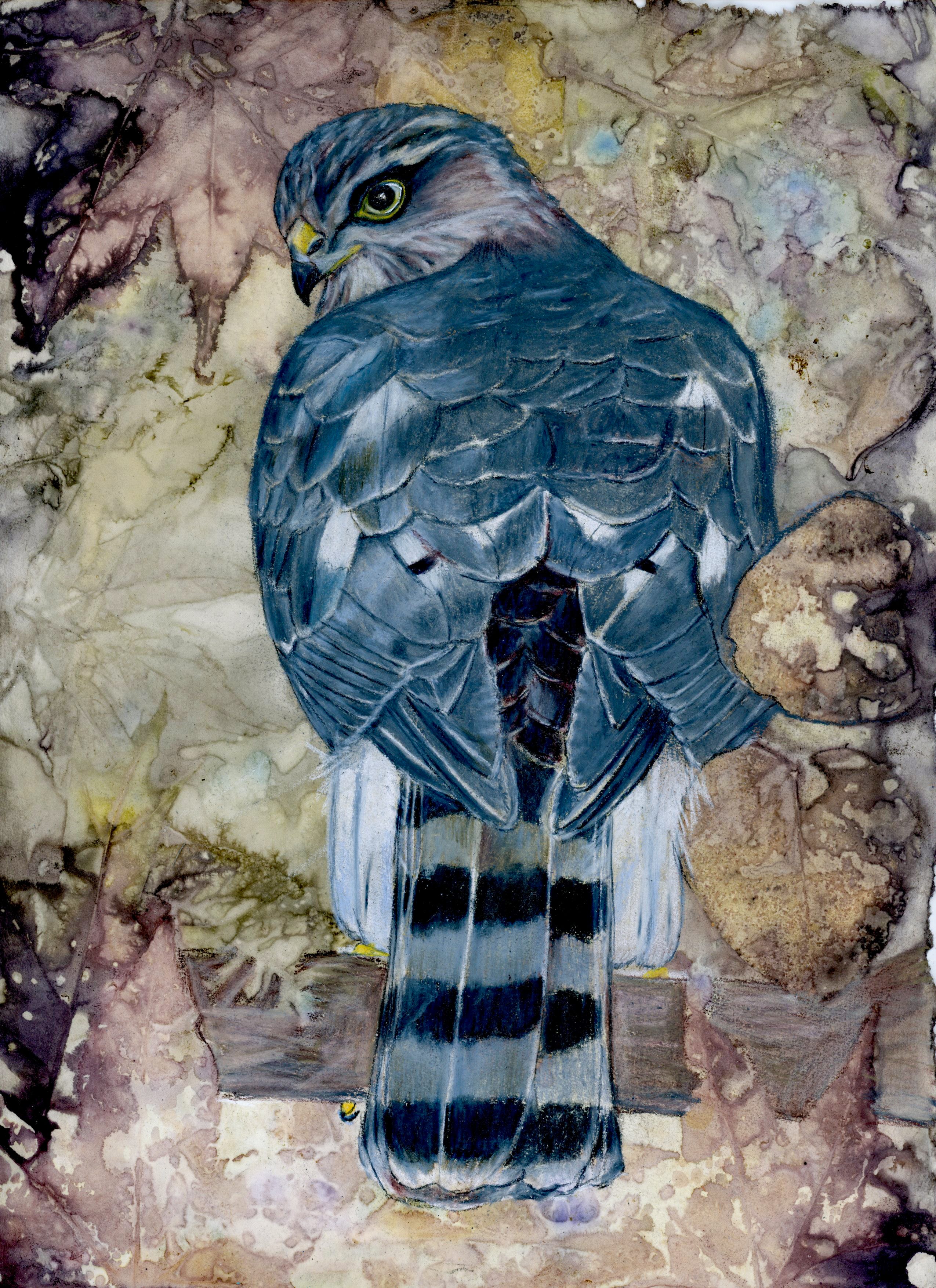
Sharp-shinned hawks have always been a mystery to me. While I have worked with and hunted with quite a few Cooper’s hawks and regularly watch them in my neighborhood, sharpies are elusive. Smaller, more wary, and experts at vanishing, they are seldom seen in my yard. When I do see one it is a marvel.
This winter, when a sharp-shinned hawk zipped above my head and landed in the backyard live oak, I gasped and thought, “sharpie!” It was something in the wingbeat and the silhouette. Not that I trusted my instincts. Sharpies and Coops are notoriously hard to tell apart and the center of arguments on every bird watching group or social media page. The camera helped me confirm the identification though and indeed, a juvenile female sharp-shinned hawk who was on her first migration was haunting my backyard and my gamebird aviary.
The first migration is the most dangerous journey for juvenile birds. Young birds may burn fuel faster as their body is still maturing, meaning they may need to catch more food than adults while still gaining the skills to catch it. They are also traversing unfamiliar territory while encountering dangers that are new to them. It only takes one mistake to end their journey permanently. Most sharpies only live to be three years old in the wild and most don’t make it through their first passage.
The next day, the little sharpie was still in my yard, was making herself more visible, her focus on the birds in my aviary and I started to worry about her. So, I tossed a quail breast on top of the aviary, hoping to give her a boost. She snatched it up and packed off with it as soon as I turned to walk away and I worried more. Tame hawks are dying hawks. Desperate hawks are dead hawks and that looked like desperation to me.
Cooper’s hawks and sharp-shinned hawks are notorious for the things they do in desperation. The stories and the videos are common of the hawk that flew into someone’s house to try to grab a budgie in its cage or the hawk that grandma was able to hand grab when it tried to make a meal of one of her chickens. They do dangerous things that defy logic when their body tells them they are one meal away from dying.
Lately I think I can relate to this state in a way I never have before. Humanity also experiences desperation and it can cause us to lose our moral compass, our ethics, and our good judgement. We do odd things, dangerous things, we act out of character when our nervous system tells us we are not safe and we are helpless to change that. So many of us are acting out of pain and I had been slowly devolving into it myself and didn’t know what to do for myself, but I could do something for the sharpie.
Sharp-shinned hawks are the smallest hawk in North America, their metabolic rate is high, and they have almost no margin to withstand starvation. It doesn’t take long for a sharpie to become emaciated, and it happens exponentially. A few missed meals and the little hawk begins to burn muscle and might increase its energy demands by 30 to 50 percent. As the body consumes itself, desperation begins to set in. A sharp-shinned hawk lives on the metabolic knife’s edge.
The little hawk was back the next day, tamer than before, sitting in the open and meeting my gaze. It would be nice to think that I had earned myself a friend, but a wild sharpie is a biological machine with an inscrutable mind. This wasn’t trust or friendship. It was far more likely that flying away wasn’t worth the caloric cost. A bird in hypoglycemic crisis simply cannot mount a normal fear response.
So, I made my own calculations, took stock of the medications in my raptor supplies, and then I tossed a bal-chatri trap with bait underneath her. She hit the trap, her toes tangling in the slip knots with me standing five feet away. It was a desperate move on her part, but unlike most hail Marys, this one would pay off.
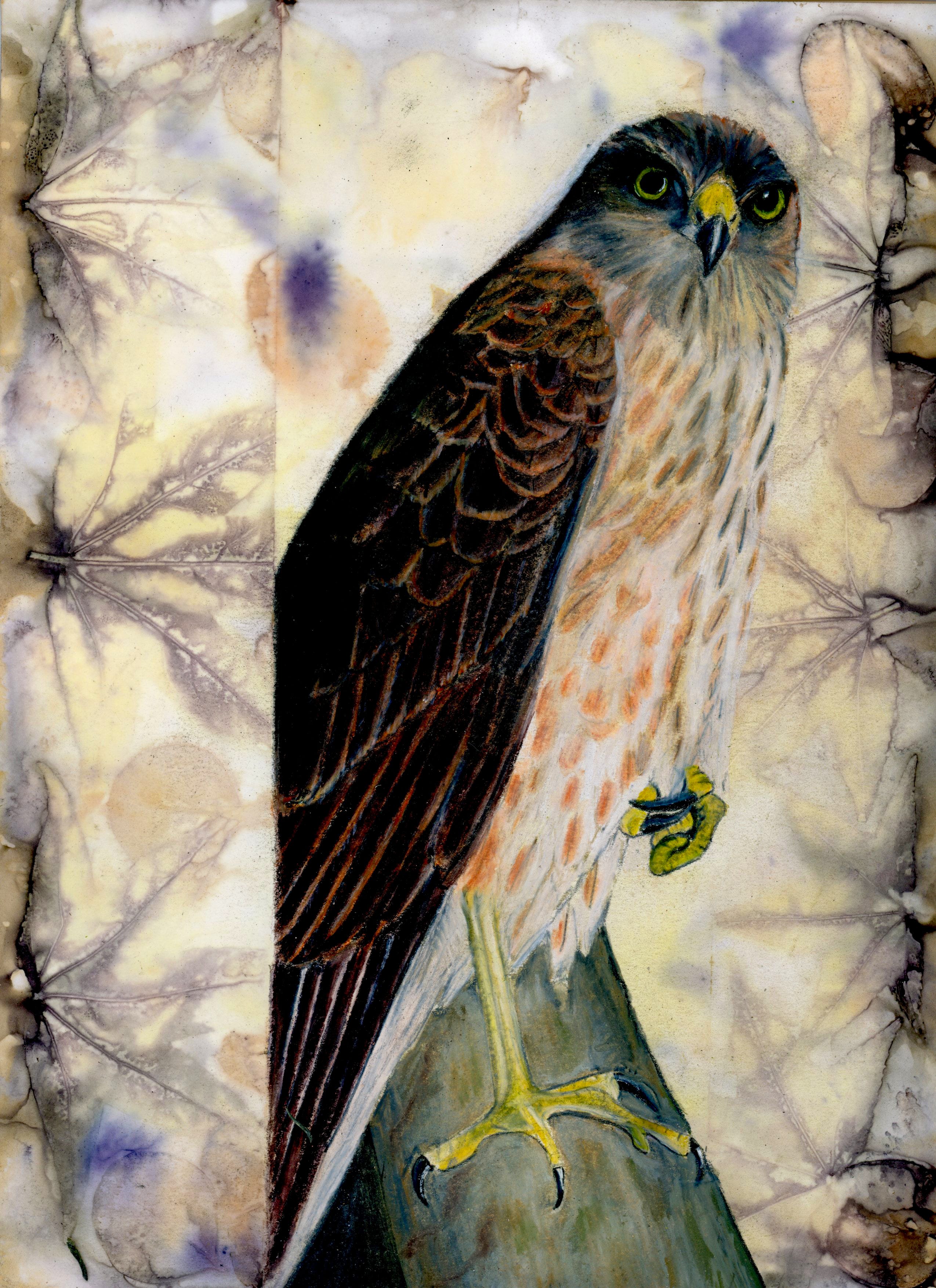
In humans, desperation is defined as a state of hopelessness, helplessness, and despair that occurs when there seems to be no viable solutions to a person’s current state. It comes with a sense of urgency and a strong desire for relief. Psychologists have only recently tried to define desperation as a separate state from anxiety and stress, although the three are hard to untangle.
Recently diagnosed with PTSD, anxiety, and depression, I could recognize the familiar desperation of a passage bird in distress, but I ignored my own. I met with my therapist and my psychiatrist, took my medications, and tried to calm myself with logic when I had night terrors, telling myself that I just needed to be stronger. After all, all my friends were struggling right now and somehow, they were muscling through. I just needed to get better at it. I told myself I had a roof over my head. I had food in the cupboard. I wasn’t a starving sharp-shinned hawk, but humans can starve in so many other ways.
I hooded the little hawk and perched her in a box where she could be still and calm. I weighed her several times a day, entering her weight into a spreadsheet and calculating how many grams she was burning an hour. She was burning 3 grams of food an hour at the beginning. A high rate of burn for 172g hawk. I began treating her with one medication crushed in her food at a time, starting with treating for coccidia, then aspergillosis, frounce, and worms. It took a few weeks to run her through all the medication but her burn rate went down, her tameness went away, and though I tried to convince her I was a friend, her wildness was pure. She brightened up, held her feathers tighter, and she looked at me like I was a dangerous predator.
Admittedly, I imagined I would make friends with the sharp-shinned hawk. I imagined us hunting together and somehow navigating the narrow path of trust we would walk together. I think I thought that if I saved her, she would save me, but nature doesn’t always work that way. It didn’t matter to her that I had saved her. It mattered to her that her world was outside. She wasn’t desperate anymore and she could see the whole of her situation, and it wasn’t to her liking. Healthy and round in the keel, I gave her one last rich meal and released her to the wider wilder world.
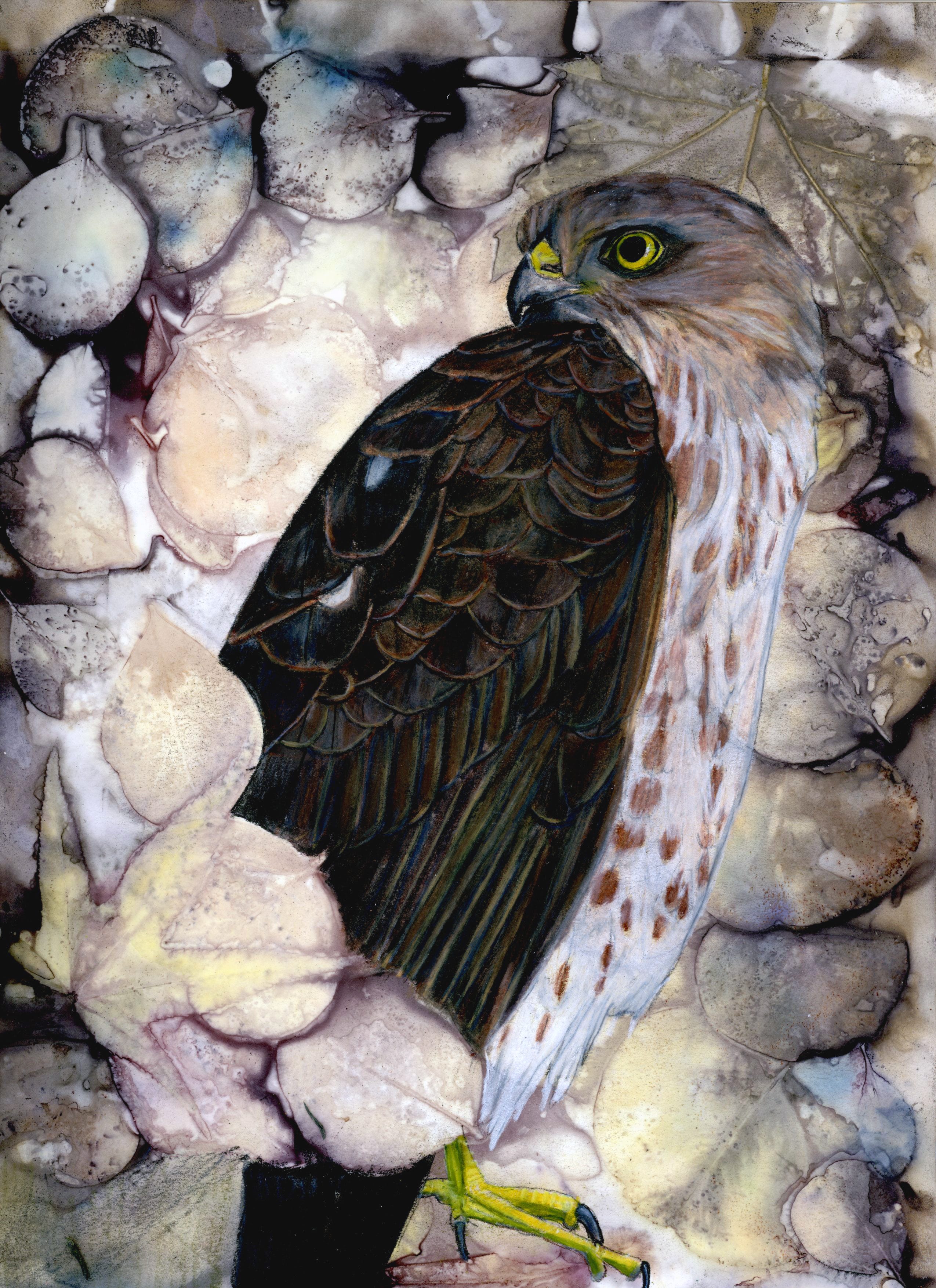
I set the sharp-shinned hawk back on her journey, but my world shrank. What should have felt like a good deed, felt like, well, nothing. She had been a lovely distraction but my falconry season with my red-tailed hawk was a disappointment. I was walking for an hour and half and not seeing a single rabbit in places where they had been plentiful the season before. It was likely that rabbit hemorrhagic fever was decimating the population again, but I didn’t know for sure and kept hoping rabbits would reappear. In the meantime, my hawk began to fly off into the distance, hoping that I would call him back for food. There was nothing to hunt and he was learning bad habits. So, I ended my season in January.
Stress ratcheted up at work, the headlines I tried to buffer myself from crept in, another friend died. I hurt. I didn’t feel safe. I didn’t know how to talk about death, loss, isolation, and national news that was triggering my night terrors. I found myself standing in rooms, staring at the wall, and wasn’t sure how long I had been there. I drank to take the edge off the anxiety that shot up my blood pressure and made my heart feel like it was constantly pounding. And then I showed up at a Zoom meeting with my Board of Directors and leadership partner slurring my words but still trying to pretend that I was just fine. I wasn’t just fine though and for the first time, everyone else could see it. I showed up desperate.
I made a couple of calls that night, sobbing that the only solution was going to rehab, but having no idea what to do with my animals. And when there was no help because I didn’t know how to ask, no answers to how to fix myself, and no emotional energy to figure it out, I just collapsed. I spent the next four days curled up in my bed, heart pounding, covered in sweat feeling like I was trying to break a fever that was more likely to break me first.
No one told me that you don’t have to be a black-out binge-drinking drunk to need to detox rather than going cold turkey. I drank 3 or sometimes 4 Buzzballs every evening and had for a month, but I didn’t keep alcohol in the house. So, I went cold turkey, detoxing alone on top of a major anxiety attack, thinking only of everyone I had let down and what a disappointment I was as a person. And that’s where I was on my 55th birthday, in bed, unable to hold down food, covered in heat rash, exhausted, alone, and just wanting it all to be over. All of it.
Five days later, I got up. I took a shower, sat down at my desk and wrote out a timeline of the four months that led up to the moment when I broke. I wrote it to show that I had been trying to get professional help for months, but what came to light was a rapid-fire series of events out of my control that piled on grief, fear, and despair. I had pulled myself up by my bootstraps, but all the while I let my emotional-self starve and diminish to point of disintegration. And I didn’t understand why I did this to myself.
Neither did the professionals helping me. They wondered what they had missed and why they hadn’t seen that I was getting worse instead of better. My psychiatrist had new questions. Had I ever had periods of feeling like I could take on the world and days where I didn’t need sleep? Of course I had, didn’t everyone? But I hadn’t felt that way for quite some time and I missed the highs even though they only lasted a few days. When I felt like this, did I buy things and start new projects that I didn’t finish? Yeah. That’s what artists do. Had anyone ever suggested that I might have Bipolar II? Sometimes I joked that I was bipolar. Bipolar II, I was corrected and it was a working diagnosis, but suddenly turbulent pieces of my life made more sense. I asked what I needed to do and was told I was already doing the first thing. Stop self-medicating. Stop drinking.
There was no doubt that I needed recovery, but I didn’t have an easy answer to what recovery looked like. I spent a month going to AA meetings every day. I read along in the texts and introduced myself as an alcoholic. I tried to take it to heart when I was told repeatedly that alcoholism is a “fatal spiritual malady”, but sobriety didn’t feel like the real challenge. It would have felt more honest to say, my name is Rebecca and I’m desperate, but I don’t know what I’m desperate for.
I’m 80 days sober now, and I don’t yearn to have a drink, I yearn to feel connected again, to have small moments of surprise and joy again. I yearn to feel safe because I belong to a larger whole.
So, I found myself back here, at Written Bird and working on my book A Field Guide to Awe: Recovering Wonder and Connection in Twelve Weeks. Nature girl heal thyself.
The sharpie and I both showed up impaired, unable to see the future, unable to seek help, because we didn’t believe there was help to be found. I saw the sharpie’s last-ditch hope for recovery, an improbable one, a human— and I answered. I answered because in my backyard, I am a piece of the natural world. And I think the best answer to healing, to becoming, and to magic in moments of desperation is always nature. I helped her and I could help myself. I could give myself care and a big dose of wilder places.
I have spent the last two months spending 20 minutes a day outside observing, keeping a notebook of moments of awe, and having a monthly nature date with my camera in hand and curiosity at the ready. I finished a month of essays and art to make sure that Written Bird keeps a steady release of content. And this month I start living A Field Guide to Awe one chapter at a time starting with a sense of place. I never imagined this book as a recovery guide, but for me that’s what it’s going to be. I’ll be writing, drawing, photographing, and exploring my way past desperation.
I released the sharpie after her recovery and I may never see her again, but maybe she’ll see me. I’ll be outside. I’ll be giving myself the same level of care I gave her. We both wanted to be healthy and free and perhaps we both will be granted the same. I won’t get to know her journey, but I welcome you to join me on mine. There is a lot of healing to be done and I’m pretty sure I’m not the only one desperate to find it.
If this essay found you in a hard place — I see you. 988 (call or text) is the Suicide & Crisis Lifeline. You don't have to be in crisis to use it. Sometimes you just need to talk to someone.
Rebecca, this is a beautiful article. Thank you for sharing such vulnerability. I’ve no doubt that you will find your wild again, like the hawk.
Sometimes breakthroughs only occur after times of desperation. I’m glad you are writing and we are better for it.
I received this beautiful postcard in the mail yesterday. Thank you Rebecca! I love it.