

Harlequin
Disrespect for danger, masks, and high-order work

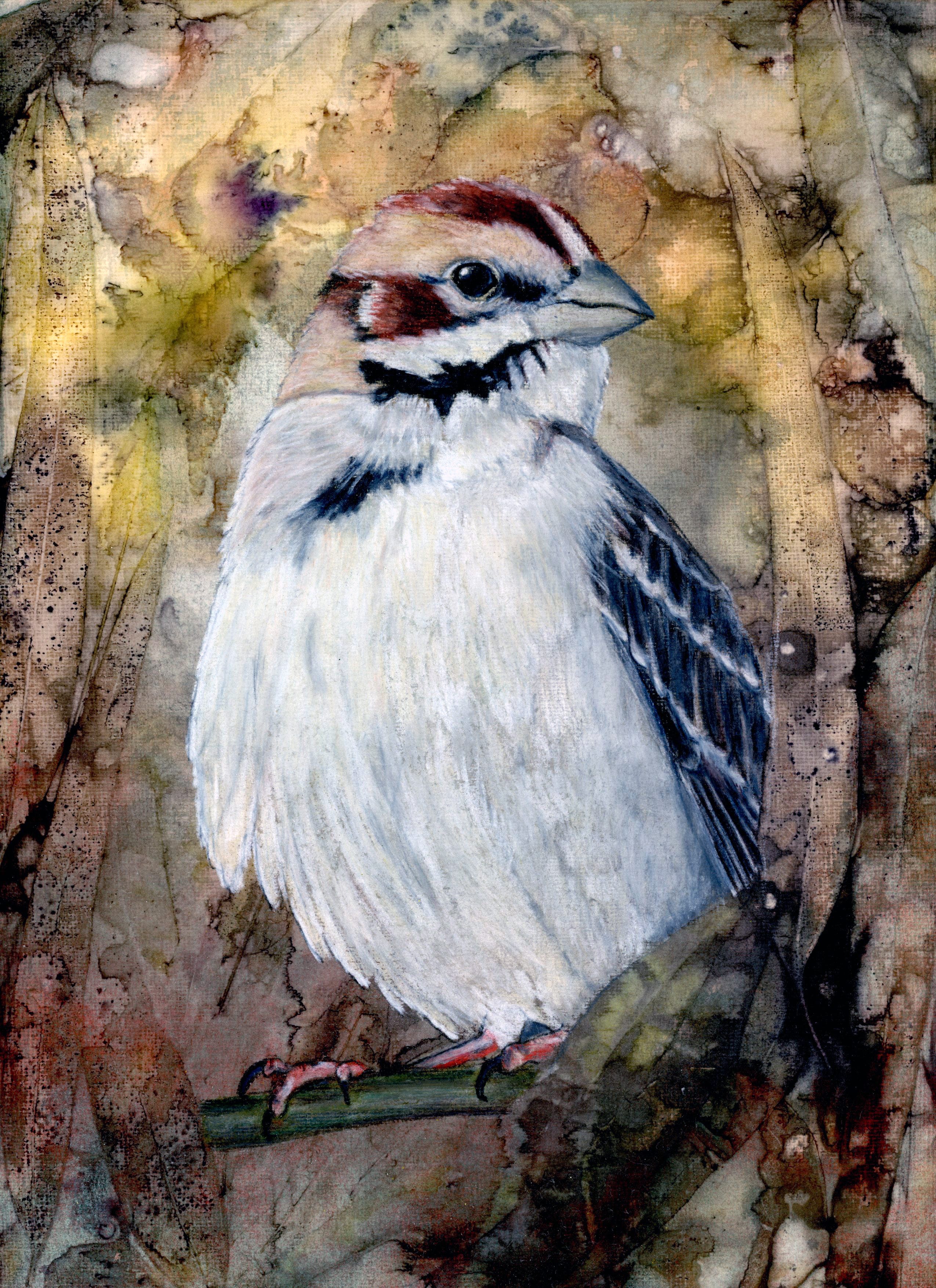
Lark sparrows are my favorite American sparrow species. There are 48 or so species of sparrow in the United States and for the most part their markings are reliably cryptic. There is a reason you get to call them, “little brown jobs” when you first begin birding. They have a diverse mixture of similar markings in sepia and grayscale, but at a glance, what you see is brown. Unless you are looking at a lark sparrow.
Sure, lark sparrows are also brown, but with chestnut harlequin face markings and white tail spots that rebel against the norms of its tribe. They arrive dressed for attention and they always get mine. There is a disrespect for danger in the lark sparrow’s demand to be seen. And I know I’m not the only one who finds that irresistible.
People love a harlequin. They have since the trickster first appeared in the 16th-century Italian Commedia dell’arte, demanding attention with slapstick comedy. It wasn’t enough for a harlequin to walk across the stage. He had to punctuate an action with cartwheel, bring attention to a prank with a departing somersault. When physical comedy wasn’t enough to hold our attention, he spoke truth to royalty through mockery and misdirection. The more dangerous it was for the harlequin to draw attention, the more closely we watched. And as the harlequin evolved through the centuries, he never lost our attention.
I learned a few years ago through the decoding of DNA that my great-grandfather was not Thomas O’Connor, but in fact a vaudeville actor. I am almost certain that my grandfather, Howard, knew that Thomas was not his father and that we were not O’Connors. He hadn’t even been listed in Thomas’ obituary as next of kin along with his half siblings. It must have been something he knew if only from whispers and glances.
I do not think he knew, however, that his father and his uncle were a long-running vaudevillian comedy tumbling act. Because if Howdy, who raised me, had known that we were harlequins by blood, he would have spun me stories worthy of my imagination. He would have nodded his head in understanding when I was pulled to the stage, the lead in the high school musical. He would have understood why I ran away to do the bird show at Disney’s Animal Kingdom the year after he passed away. He would have warned me that it was dangerous to draw an audience’s attention but would have shrugged when I chased it anyway.
My great-grandmother, Zelda Pearl, was 14 years old when De Los Sylmar Aspril and his brother James performed in Western Pennsylvania in 1911 as the Astella Brothers. Nine months later my grandfather was born, but Zelda didn’t marry Thomas until she was 17 and my grandfather was 19 months old. When Thomas died in 1920, my grandfather’s four O’Connor siblings were listed as next of kin. Howard was not.
He was something else, the product of a teenager and a brief encounter with a young showman. I’m not sure which of the brothers is my great-grandfather. The DNA available to link us is through the Aspril brothers’ sister, but it is close family DNA and it is mine. In 1926, the brothers were reviewed as a hit and lauded for their “high-order work,” acrobats praised for the risks they took. It is dangerous to be a harlequin, and it is grand. I wish my grandfather could have shared this secret. There is so much to say and unravel and revel in. There is so much sense to be made from my love of harlequins.
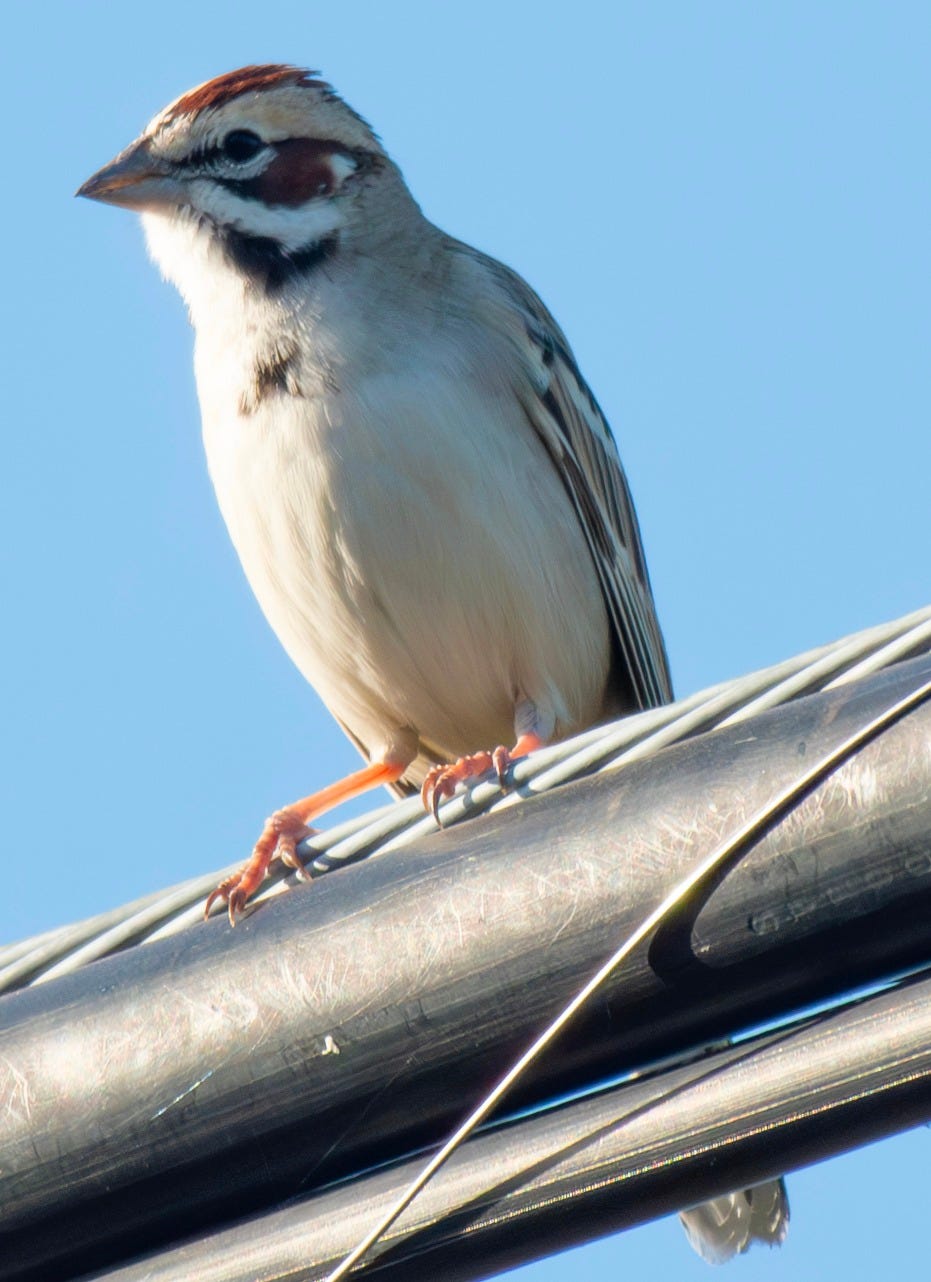
It doesn’t seem like a good survival strategy to stand out in a field of sparrows with a harlequin face. I bet my grandfather knew this in his soul, even if he was never told the truth of it. The Italian commedia dell’arte troupes were banished from France in 1697. Their distracting costumes and acrobatics eventually weren’t enough cover for satirizing the Queen for her piety and moral reformism. You cannot perform for your chosen audience and not also be on display to the hawks. I bet my grandfather learned to hide his face. Maybe it’s why he lied about age, leaving home to join the Army at 17 years old.
Eventually, King Louis XIV died, and the harlequin returned to France in 1716. So, I guess you can hope to escape and outlive any predators you provoke. And if you do, then you can always return to the stage.
It’s a strategy that seems to have worked for the lark sparrow. Both male and female are identical in flashy plumage. The sole member of the genus Chondestes with no close relatives, there are no other American sparrows with similar face markings. They also stand out for their unusually long rounded tail with prominent white corners that flash in flight. So, the grasslands harlequin must have a niche that serves them well enough to risk drawing attention to themselves.
I wonder if my grandfather would encourage me to embrace my lineage. I wonder if he would tell me to keep it close and secret. I only knew Zelda Pearl as great-grandma Hullihen, who had taken the name of her second husband. I knew her from the somber Mother’s days when my grandfather and grandmother would take me with them to lay flowers on her grave. But I wonder what Zelda would tell me if she could. Maybe Zelda was a harlequin too, but she learned to hide from the hawks. Maybe she had no choice.
Other sparrow species are just as intricately marked and as beautiful as a lark sparrow if you give them your attention. It just takes more time to pause and to admire them. I know this because I photograph and draw them when I find them. And I find them spectacularly beautiful, but it is the lark sparrow that makes my heart jump in my chest, the sparrow that feels like kin. An eye-catching bird with a mask and secrets. A great-grandmother with the same. Sometimes that is all you get to know for sure, but sometimes it is enough to discover who you are.