

Writing the Blues
Blue feathers, gray eyes, and refracted truths

(First run in the Press Enterprise, April 5, 2026)
I’ve been thinking a lot about refraction lately and how in nature and writing, reality is in the eye of the beholder. Spend any length of time observing nature and it will spin a story for you, but how you read it is up to you. Is it a triumph that the Cooper’s hawk is returning to its nest with a house finch for its voracious chicks. Or is it a tragedy that the fragile finch chicks have one less parent to feed them. Nature loves this communion between the observer and reality so much that it is frequent and layered.
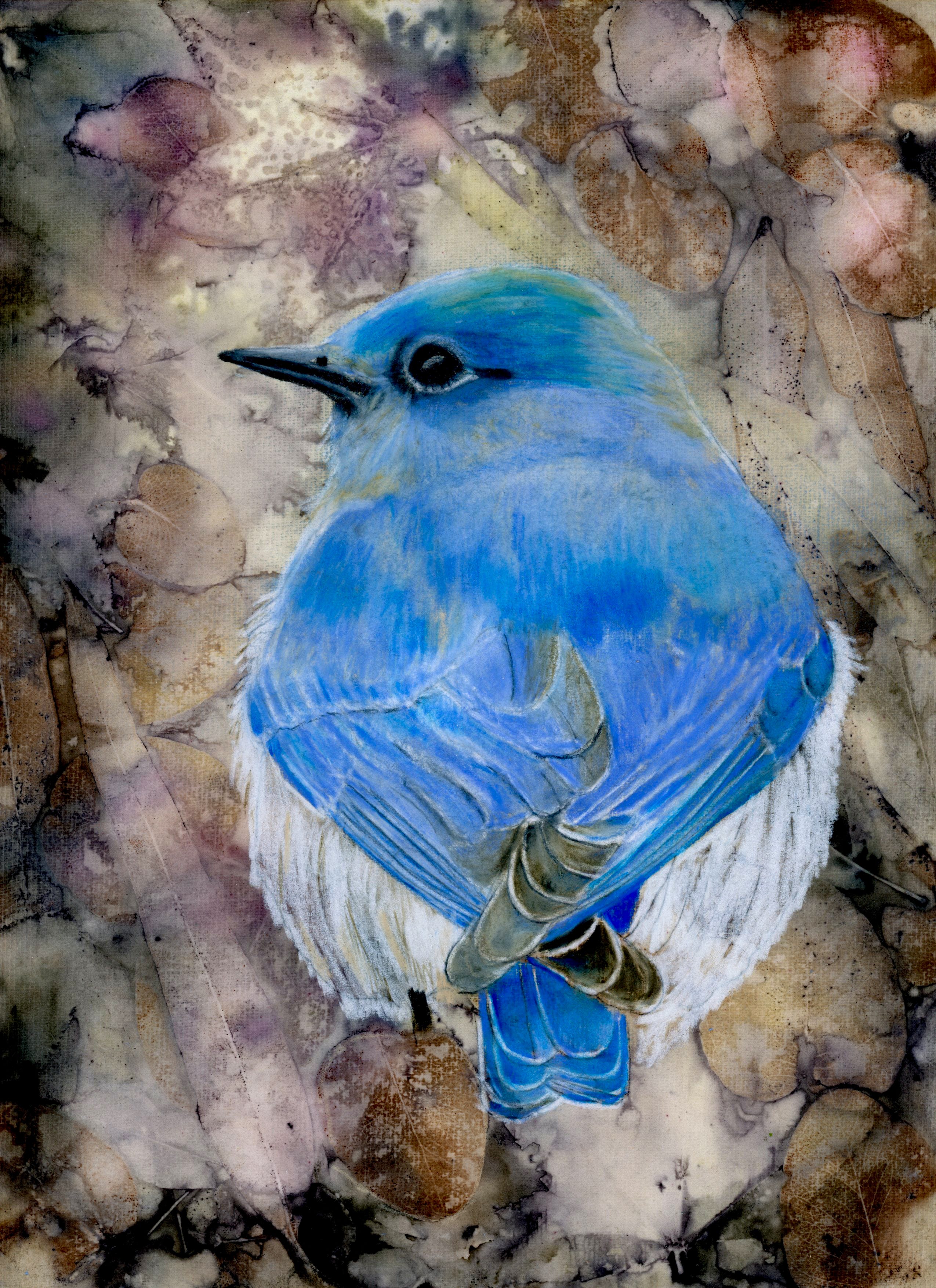
This winter I spent time at San Jacinto Wildlife Area trying to get a perfect photograph of a mountain bluebird. Bluebirds hold a firm place in many cultures as a representative of happiness or joy. There is something about the color blue on a living creature that elicits a feeling of well-being, and the mountain bluebird is the purest most saturated shade of sky. I wanted to capture that shade and the feeling. I got my photo, but I couldn’t help pondering the fact that the color was not real.
Whether it is a western, eastern, or mountain bluebird, none of them are actually blue. If you were to find a bluebird feather and grind it up to powder, what remained would be gray. The bluebird of happiness isn’t actually blue at all.
Blue feathers are structural colors and rather than storing color chemically in cells, the feather barbs contain microscopic structures that interact with light. They absorb some wavelengths and scatter others back toward the viewer. A bluebird’s feathers scatter blue wavelengths and absorb the rest. The color is not a property of the bird. It’s only blue if someone is there to observe it in the light.
Then you must wonder if we are all observing the same shade of blue. After all, your eyes may be structurally different in function than mine and even a different color. Although we would probably disagree on what color my eyes are because they are gray.
Gray eyes contain almost no pigment. The iris stroma, the layer that gives eyes their color, also has more collagen than other eye colors, scattering all wavelengths of light more evenly. This dependence on structural light scattering makes them changeable from gray to greenish gray to a variety of blues.
Yet, my eyes are not blue, and neither are bluebird feathers. Blue belongs to whoever is looking. The blue belongs to the reader.
I sometimes find myself struggling to craft words that leave no room for interpretation or feelings other than my own. I want everyone to see the colors I am seeing. I know what I mean, and I want the reader to feel triumphant for the hawk. More than that I want them to know me, the writer, exactly as I represent myself on the page. Despite a lifetime of arguing about something that should be as straightforward as the color of my eyes, I still think I can control refraction and how my story is read. Yet, I think perhaps, what the reader brings is as important as what I present to them.
Perhaps writing that leaves room for the light to refract is doing nature’s work. I can create the conditions for meaning, but I can’t control the light source. I can’t control what the reader carries into the encounter. I can leave them room to lean into a recent loss and feel for the finch if that’s what they bring to the page. Or perhaps the reader will come to the page on the high of new romance and root for the hawk as I secretly did.
If I can manage to leave room for refraction, perhaps someone I’ve never met, in a moment I couldn’t have predicted, in a light I didn’t know existed, will find themselves in my words. And if I left enough space for it, perhaps the words will refract into a seemingly impossible shade of blue, a shade that only this particular reader can see.
My God woman this is *magic*
Rings true. Communication and understanding are complex. We try.